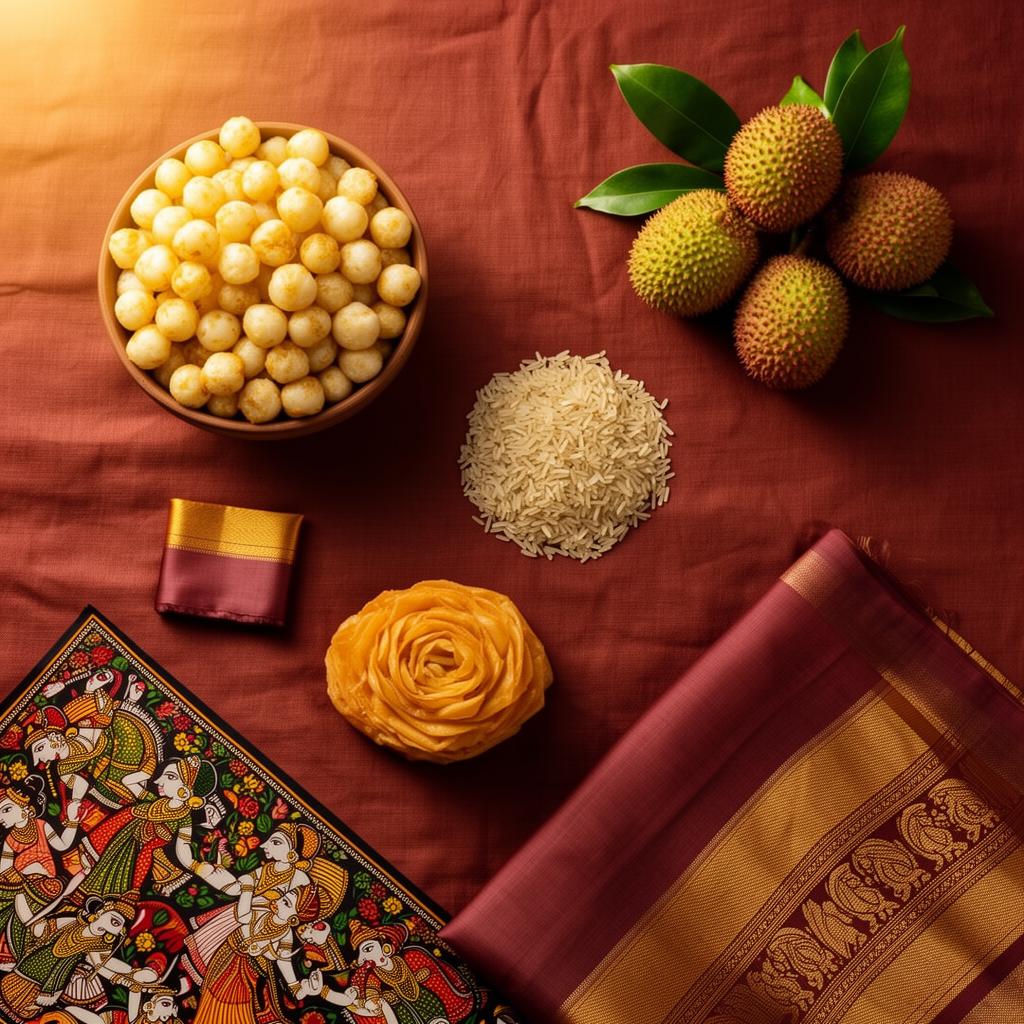
GI-Tagged Products of Bihar: Complete List 2026 (All 13 Heritage Products)
Founder, RootWell · Lost 20kg with Ayurveda · 5+ yrs in traditional digestive wellness, trained under family practitioners in Bihar.
As of June 13, 2026, Bihar's GI registry just grew by three — Bawan Buti saree (Nalanda), Patharkatti stone craft (Gaya), and Pidiya painting — taking the state's count to 13 GI-tagged products. For a state that is constantly under-marketed, this is the official portfolio that proves Bihar has been producing world-class heritage goods for centuries.
This is the complete, sourced list — agricultural, food, handicraft and handloom — with the year of registration, the region, and what each product actually is. Bookmark this; it's the one page you'll need.
The 30-second answer
Bihar currently has 13 GI-tagged products spanning food, agriculture, handicraft and handloom — registered between 2007 and June 2026. The biggest names are Madhubani Painting, Bhagalpur Silk, Shahi Litchi, Mithila Makhana, Silao Khaja, Magahi Paan, and (newest) Bawan Buti.
What Is a GI Tag? (Quick Recap)
A Geographical Indication (GI) is a legal certification, governed by India's Geographical Indications of Goods (Registration and Protection) Act, 1999 and administered by the Controller General of Patents, Designs & Trade Marks (Chennai). It protects products whose quality, reputation or characteristics are tied to a specific geography. Once tagged, only producers from that registered region can legally sell the product under that name — similar to Champagne (France) or Darjeeling Tea.
The Complete List — Bihar GI Tags (Updated June 2026)
| # | Product | Category | Region | Year |
|---|---|---|---|---|
| 1 | Madhubani / Mithila Painting | Handicraft | Mithila (Madhubani, Darbhanga) | 2007 |
| 2 | Applique (Khatwa) Work | Handicraft | Bihar | 2008 |
| 3 | Sujani Embroidery | Handicraft | Bhusura, Muzaffarpur | 2008 |
| 4 | Sikki Grass Products | Handicraft | Mithila region | 2008 |
| 5 | Bhagalpur Silk | Handicraft (textile) | Bhagalpur | 2013 |
| 6 | Bhagalpuri Zardalu (Jardalu Mango) | Agricultural | Bhagalpur | 2018 |
| 7 | Katarni Rice | Agricultural | Bhagalpur, Banka, Munger | 2018 |
| 8 | Magahi Paan (Betel Leaf) | Agricultural | Magadh (Nawada, Gaya, Aurangabad, Nalanda) | 2018 |
| 9 | Shahi Litchi | Agricultural | Muzaffarpur belt | 2018 |
| 10 | Silao Khaja | Food | Silao, Nalanda | 2018 |
| 11 | Mithila Makhana | Agricultural / Food | Mithila region (9 districts) | 2022 |
| 12 | Bawan Buti Saree | Handloom | Baswan Bigha & Nepura, Nalanda | Jun 2026 |
| 13 | Patharkatti Stone Craft | Handicraft | Patharkatti, Gaya | Jun 2026 |
| 14 | Pidiya Painting | Handicraft | Bihar (folk floor art) | Jun 2026 |
Sources: Bihar Bhawan (Government of Bihar GI Tags PDF), APEDA Bihar registry, GI Registry India (Chennai), and June 13, 2026 reporting from PTI / Times of India / NewsDrum / Patna Press for the three latest additions.
Quick Notes on Each — What They Actually Are
1. Madhubani / Mithila Painting (2007)
Bihar's most famous GI. Born on the mud walls of Mithila homes (Madhubani, Darbhanga), painted by women using natural dyes, twigs and fingers. Themes: gods, weddings, fish, lotus, tree of life. Today painted on paper, cloth, sarees and walls worldwide.
2. Applique (Khatwa) Work (2008)
Coloured cloth pieces cut into shapes (peacocks, elephants, flowers) and stitched onto a base fabric — used for tents (shamiana), wall hangings and festival canopies.
3. Sujani Embroidery (2008)
Originally a Bhusura (Muzaffarpur) tradition of stitching old saris together with running embroidery to make soft baby quilts. Today, a recognised art form depicting social stories and women's lives.
4. Sikki Grass Products (2008)
A golden-coloured wild grass (Sikki) woven by Mithila women into baskets, dolls, boxes and ritual gift containers given at weddings.
5. Bhagalpur Silk (2013)
Also called Tussar / Tasar silk. Bhagalpur ("Silk City") has been weaving wild-cocoon tussar for over 200 years. Lustrous, breathable, naturally golden — used for sarees, scarves and home furnishings.
6. Bhagalpuri Zardalu / Jardalu Mango (2018)
A small, intensely aromatic, fibreless mango grown in Bhagalpur. Eaten fresh, never juiced. Highly perishable — which is why most Indians outside Bihar have never tasted it.
7. Katarni Rice (2018)
A small-grain, intensely aromatic rice from Bhagalpur, Banka and Munger districts — used almost exclusively to make chura (flattened rice / poha) and kheer. Once a royal rice; still hand-pounded in many villages.
8. Magahi Paan (2018)
The legendary betel leaf of the Magadh region (Nawada, Gaya, Aurangabad, Nalanda). Soft, melt-in-the-mouth, with no bitterness. Considered the world's finest paan leaf.
9. Shahi Litchi (2018)
India's most famous litchi — grown in the Muzaffarpur belt. Thin red skin, juicy fragrant pulp, small seed. Bihar produces roughly 40% of India's litchi crop and Shahi Litchi is its crown.
10. Silao Khaja (2018)
A 52-layered (yes, 52 again) flaky sweet made of refined flour, ghee and sugar syrup — made only in Silao town (Nalanda district). Believed to have been offered to Lord Buddha. A road-trip ritual for anyone driving through Nalanda or Rajgir.
11. Mithila Makhana (2022)
India's first superfood. Hand-popped from prickly Makhana seeds (Euryale ferox) grown in 9 districts of Mithila. Bihar produces ~85% of the world's makhana. See: Mithila Makhana vs regular makhana →
12. Bawan Buti Saree (June 2026) — NEW
A handwoven cotton-silk saree from Baswan Bigha & Nepura villages of Nalanda, carrying 52 small extra-weft motifs (lotus, bodhi tree, fish, conch, peacock). 10–20 days of handwork per saree. Read the full Bawan Buti story →
13. Patharkatti Stone Craft (June 2026) — NEW
A 300-year-old black-stone (kasauti) carving tradition from Patharkatti village in Gaya district. Idols, mortars, plates and architectural panels carved entirely by hand.
14. Pidiya Painting (June 2026) — NEW
A folk floor-painting tradition done by Bihari mothers and grandmothers during festivals (especially Chhath, Tusari, weddings). Made with rice paste, vermilion and turmeric on the threshold and courtyard — a household ritual finally getting its formal recognition.
Why Three New GI Tags in One Day Matters
Between 2007 and 2022, Bihar accumulated 11 GI tags — roughly one every 18 months. Then in June 2026, three were granted in a single day. That is not coincidence; it reflects active state-level documentation work by Bihar Industries Department, the Upendra Maharathi Shilp Anusandhan Sansthan (Patna), and pressure from advocates like Padma Shri Kapil Dev Prasad (Bawan Buti).
Practically, more GI tags mean three things: (1) legal protection against power-loom and printed imitations, (2) eligibility for ODOP (One District One Product), Handloom Mark and APEDA export support, and (3) higher per-unit prices reaching the actual artisan instead of being captured by middlemen.
A Founder's Note
I'm Muskan, founder of RootWell. Our products — pure chana sattu and Mithila Makhana — come from the same Bihar geography as half of this list. Every GI tag on this page is a quiet vote of confidence in something my generation grew up undervaluing: that "Made in Bihar" already meant world-class, long before the world bothered to look. The list will keep growing. Pag (Mithila's traditional headgear), Marcha rice, and Nalanda's wood inlay are reportedly already in the GI pipeline.
Taste two of these GI heritages at home
RootWell's pantry is built around Bihar's GI map — Mithila Makhana (GI 2022) and pure chana Sattu, both made by women in Bihar's villages, one small batch at a time.
Sources
- Bihar Bhawan, New Delhi — Government of Bihar GI Tags (official PDF, biharbhawan.gov.in)
- APEDA Bihar — Geographical Indication registry (apeda.gov.in/Bihar)
- Geographical Indications Registry, Chennai (Government of India)
- Press Trust of India / NewsDrum — "Bihar's Bawan Buti sarees, Patharkatti stone craft, Pidiya painting get GI tag", 13 June 2026
- Times of India — "Bawan Buti Sari, Pattharkatti Stone Craft & Pidhiya Painting get GI tag", 13 June 2026
- News9 — "From Madhubani paintings to Shahi Litchi: List of GI-tagged specialties from Bihar"
Sources & Further Reading
- Ministry of AYUSH, Government of India
- NIH NCCIH — Ayurvedic Medicine: In Depth
- PubMed — Peer-reviewed research on Ayurveda & digestion
- World Health Organization — Traditional Medicine
Medical disclaimer: This article is written by Muskan Kumari and reviewed on 1 Oct 2026. It is based on classical Ayurvedic texts, lived personal experience, and publicly available research — and is for educational purposes only. It is not a substitute for professional medical advice, diagnosis, or treatment. Always consult a qualified healthcare practitioner for medical conditions, especially if you are pregnant, nursing, or on prescription medication.