Bawan Buti Gets GI Tag (June 2026): The 52-Motif Handloom Heritage of Nalanda, Bihar
Founder, RootWell · Lost 20kg with Ayurveda · 5+ yrs in traditional digestive wellness, trained under family practitioners in Bihar.
On June 13, 2026, three of Bihar's most quietly beautiful crafts officially became part of India's Geographical Indication (GI) registry — Nalanda's Bawan Buti saree, Gaya's Patharkatti stone craft, and the Pidiya floor painting of Bihar's mothers and grandmothers. For someone like me — born in this region, watching my grandmothers fold these sarees into steel trunks every wedding season — this isn't a press-release headline. It is a 200-year-old village finally being heard.
This is the honest, founder's-eye guide to what Bawan Buti actually is, where it comes from, why it has 52 motifs, what the new GI tag changes, and why every Bihari household should care.
The 30-second answer
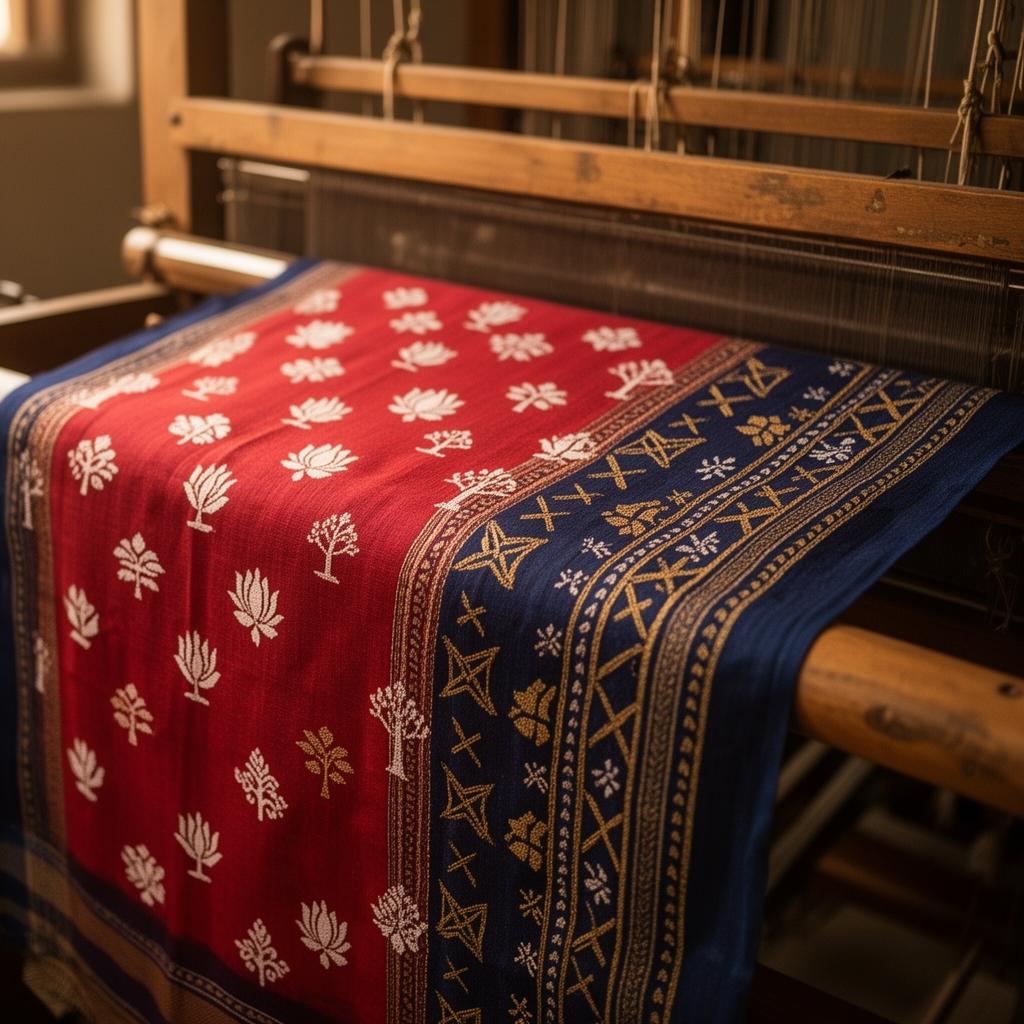
Bawan Buti (literally "fifty-two motifs") is a handwoven cotton-and-silk saree from the village of Baswan Bigha & Nepura in Nalanda district, Bihar. Each saree carries 52 small extra-weft motifs — lotus, bodhi tree, fish, conch, peacock, sun, moon, geometric stars — woven entirely by hand on a pit-loom. The craft survives in roughly 50–60 weaver households today and was awarded a GI tag by the Government of India on June 13, 2026 (reported by Times of India, PTI, NewsDrum and Patna Press the same week).
What "GI Tag" Actually Means (Plain English)
A Geographical Indication tag, administered by the Controller General of Patents, Designs & Trade Marks under India's Geographical Indications of Goods (Registration and Protection) Act, 1999, certifies that a product genuinely originates from a specific place and that its qualities are inseparable from that place. Darjeeling tea, Kanchipuram silk, Mysore sandal soap, Mithila Makhana (2022), Madhubani painting and Banarasi saree all carry GI status.
For Bawan Buti, this means three real things: (1) only sarees genuinely woven in the registered Nalanda cluster can legally be sold as "Bawan Buti", (2) weavers gain protection from cheaper power-loom imitations sold in city markets, and (3) the cluster becomes eligible for central government schemes like the Handloom Mark, ODOP (One District One Product) funding, and export support through the Development Commissioner (Handlooms).
Why "52" Motifs? The Honest Origin
The name Bawan Buti comes from Hindi: bawan = 52, buti = small motif. There are several traditions explaining the number 52, and historians do not fully agree — which is itself a sign of how old the craft is:
- Buddhist iconography theory — Nalanda was the seat of Mahavihara, the world's first residential university (5th century CE). One school of art historians (cited by Oaklores and the Bihar Museum) traces the 52 motifs to 52 auspicious Buddhist symbols woven as a meditation aid for monks.
- 52 herbs theory — Local weaver families in Nepura describe the 52 motifs as representing the 52 medicinal herbs traditionally grown in Nalanda's monastery gardens — a story echoed by Bihar Tourism's own publicity.
- 52 weeks theory — A third reading: 52 motifs = 52 weeks of the year, marking the saree as a complete annual cycle, often gifted at weddings as a blessing for "a full year of prosperity".
All three may be true. What is documented is that the motifs themselves are repeatedly identifiable across surviving sarees: kamal (lotus), bodhi vriksha (bodhi tree), machhli (fish), shankh (conch), mor (peacock), chand-sitara (moon and stars), swastik, diya, geometric eight-point stars, paisleys and the temple-shaped triangle.
Where It Is Made: Baswan Bigha & Nepura
The craft is concentrated in two clusters in Nalanda district — Baswan Bigha (about 10 km from Biharsharif) and Nepura village (about 25 km from Rajgir). Together they hold an estimated 50–60 active weaver families today, down from several hundred in the 1970s, per reporting by The Rise (Nov 2025) and Patna Press.
The single most recognised name in the revival is Shri Kapil Dev Prasad of Baswan Bigha, awarded the Padma Shri in 2018 for his lifetime work in preserving Bawan Buti. His work — including the celebrated piece "Lord Buddha and Mahabodhi Temple" — is part of the permanent collection at the Bihar Museum in Patna.
How a Bawan Buti Saree Is Actually Woven
This is not a print. It is not a power loom. It is not embroidery added on top. Every single motif is woven into the fabric itself by hand using the extra-weft technique:
- The base fabric: Cotton warp threads stretched vertically on a traditional pit-loom (often 800–1000 warp threads across a 48-inch width).
- The plain weave: A cotton weft is passed horizontally to build the body of the saree.
- The 52 motifs: At pre-counted intervals, the weaver pauses, lifts specific warp threads with their fingers, and inserts a second weft thread — usually mercerised cotton, sometimes silk or zari — purely to form one motif. This is repeated 52 times across the body of the saree.
- Time: A single 6-yard saree takes 10 to 20 days of full-time work by a master weaver. There are no shortcuts.
The result is reversible — both sides of the saree show the motif cleanly. That reversibility is the easiest at-home test to distinguish a real handwoven Bawan Buti from a printed or power-loom imitation.
How to Identify a Genuine Bawan Buti (Buyer's Checklist)
| Marker | Real Bawan Buti | Power-loom imitation |
|---|---|---|
| Motif on the reverse side | Clean & legible | Floating threads / messy |
| Motif spacing | Slightly irregular (human hand) | Mathematically identical |
| Hand-feel | Soft cotton, slight weight, breathes | Stiff, plasticky drape |
| Selvedge (kinara) | Tightly woven by hand | Machine-finished |
| GI / Handloom Mark | Tag from registered cluster | Absent or fake |
| Price band (2026) | ₹4,500 – ₹18,000+ | Often ₹800 – ₹2,500 |
Price ranges based on weaver-direct rates published by Bihar Khadi & Village Industries Board and field reporting from Nepura/Baswan Bigha clusters, 2025–26.
Why This GI Tag Actually Matters — A Founder's View
I run RootWell, a 100% women-led wellness brand from Bihar. I sell sattu and makhana — not sarees. But I am writing this because the GI tag for Bawan Buti tells the same story I live every day with Mithila Makhana (GI tag, 2022): Bihar's traditional crafts are world-class, they are simply under-marketed.
Three things change with a GI tag, in my experience:
- 1. Weavers earn more per saree. Verified provenance lets the cluster justify the real price of 10–20 days of work, instead of being bargained down by middlemen comparing them to power looms.
- 2. Young weavers stay. The biggest loss in Nepura over 30 years has been daughters and sons leaving for Delhi/Gujarat. A GI tag + market visibility makes weaving a viable career again.
- 3. Bihar's brand finally compounds. Mithila Makhana, Madhubani painting, Magahi paan (GI 2018), Silao khaja (GI 2018), Shahi Litchi (GI 2018), and now Bawan Buti + Pidiya + Patharkatti — that is a serious heritage portfolio. It changes how outsiders see "Made in Bihar".
How You Can Support the Weavers (Without Buying Anything)
- Share their name. Most Indians have not heard of Bawan Buti. A single Instagram/WhatsApp post linking to this blog or to Bihar Tourism's Bawan Buti page is real help.
- Buy direct when you can. Bihar State Khadi Board (Patna), Upendra Maharathi Shilp Anusandhan Sansthan exhibitions, and the official Nepura weaver cooperatives skip middlemen entirely.
- Ask for the Handloom Mark + GI tag. The moment buyers start asking, the supply chain cleans itself up.
- Gift it. Weddings, retirement gifts, corporate gifting — every Bawan Buti gifted is roughly 2 weeks of one weaver's livelihood secured.
A Personal Note from Muskan
I grew up watching my Nani fold her Bawan Buti saree into the same steel almirah every Chhath, every wedding, every Eid invitation. Back then, I had no idea those 52 small motifs carried the memory of an entire civilisation — Nalanda's monks, Mithila's painters, my grandmother's young hands. June 13, 2026 — the day Bawan Buti officially became GI-protected — is not just a craft win. It is Bihar saying out loud, "We were always world-class. You just weren't looking."
From the same soil — RootWell's Bihari pantry
Bawan Buti and RootWell come from the same Bihar — same red soil, same Nalanda-Mithila plain, same 2,500-year tradition of treating everyday objects (cloth, food, paint) as sacred. If you want to taste the food half of that heritage, our Mithila Makhana and pure chana Sattu are made by women in Bihar's villages, one batch at a time.
Sources & Further Reading
- Times of India — "Bawan Buti Sari, Pattharkatti Stone Craft & Pidhiya Painting get GI tag", 13 June 2026
- Press Trust of India / NewsDrum — "Bihar's Bawan Buti sarees, Patharkatti stone craft, Pidiya painting get GI tag", 13 June 2026
- Patna Press — "Gaya's 300-Year-Old Stone Craft and Nalanda's Iconic Bawan Buti Among Three Bihar Products to Get GI Tag", 14 June 2026
- Bihar Museum, Patna — Kapil Dev Prasad collection, "Lord Buddha and Mahabodhi Temple"
- Oaklores — "Buddhist Iconography to Contemporary Designs: A Journey of Bawan Buti Sarees", Jan 2025
- The Rise — "Threads of Nepura: Reviving Bihar's Handloom Heritage", Nov 2025
- Government of India — Geographical Indications of Goods (Registration and Protection) Act, 1999
Sources & Further Reading
- Ministry of AYUSH, Government of India
- NIH NCCIH — Ayurvedic Medicine: In Depth
- PubMed — Peer-reviewed research on Ayurveda & digestion
- World Health Organization — Traditional Medicine
Medical disclaimer: This article is written by Muskan Kumari and reviewed on 1 Oct 2026. It is based on classical Ayurvedic texts, lived personal experience, and publicly available research — and is for educational purposes only. It is not a substitute for professional medical advice, diagnosis, or treatment. Always consult a qualified healthcare practitioner for medical conditions, especially if you are pregnant, nursing, or on prescription medication.